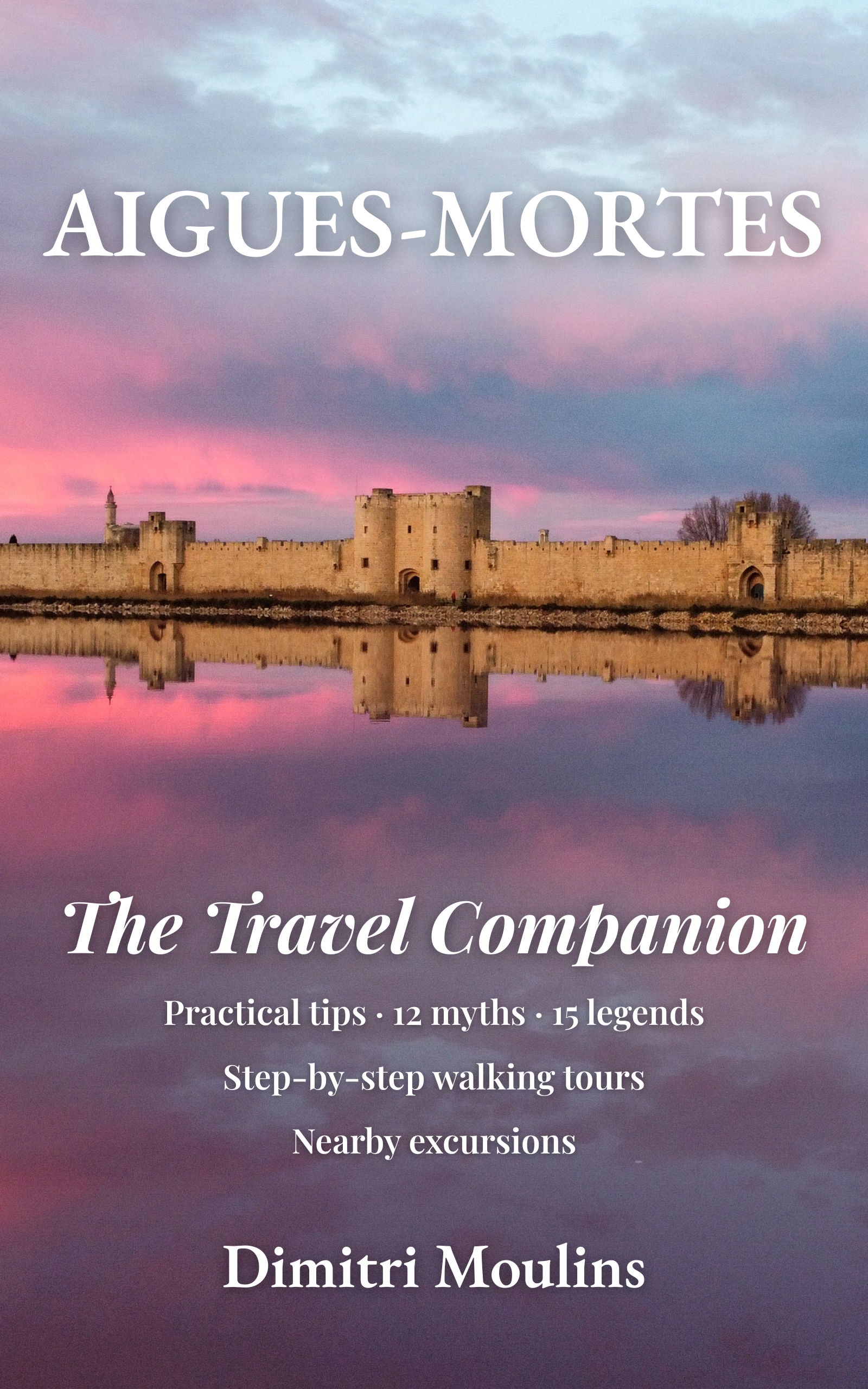
Aigues-Mortes – The Travel Companion
Aigues-Mortes is one of the best-preserved medieval towns in France – and one of the most misunderstood. This book was written by a local guide who has lived inside its ramparts for 22 years.
- A practical travel guide
- 12 myths set straight
- 15 local legends
Three books in one volume
Most guidebooks give Aigues-Mortes half a page. This one gives it a whole book – in fact, three: a guide to plan your visit, a history book that untangles fact from fiction, and a collection of the legends people have told here for centuries. Each part can be read on its own.
The practical travel guide
Everything you need to plan your visit and make the most of it on the spot:
- Getting there by car, train, plane or bike
- Where to park – with maps of the car parks and EV charging points
- A day in Aigues-Mortes, step by step
- Two self-guided walking tours, including the towers and ramparts
- Excursions to the salt works and the Camargue
- Restaurants and places to stay the author personally recommends
- Tips for families, the year's calendar and the town festival
- What is available in English on site

12 myths, set straight
Some of the stories everyone "knows" about Aigues-Mortes are repeated in guidebooks, on signs and by tour guides – and they are not always true. The author checks twelve of them against the historical sources and explains what really happened.
Did Saint Louis found the town in order to go on crusade?
Did Aigues-Mortes once stand by the sea?
Were the Templars locked up in the Tour de Constance?
With a timeline of the town's history and a quiz to test yourself at the end.
15 legends of Aigues-Mortes
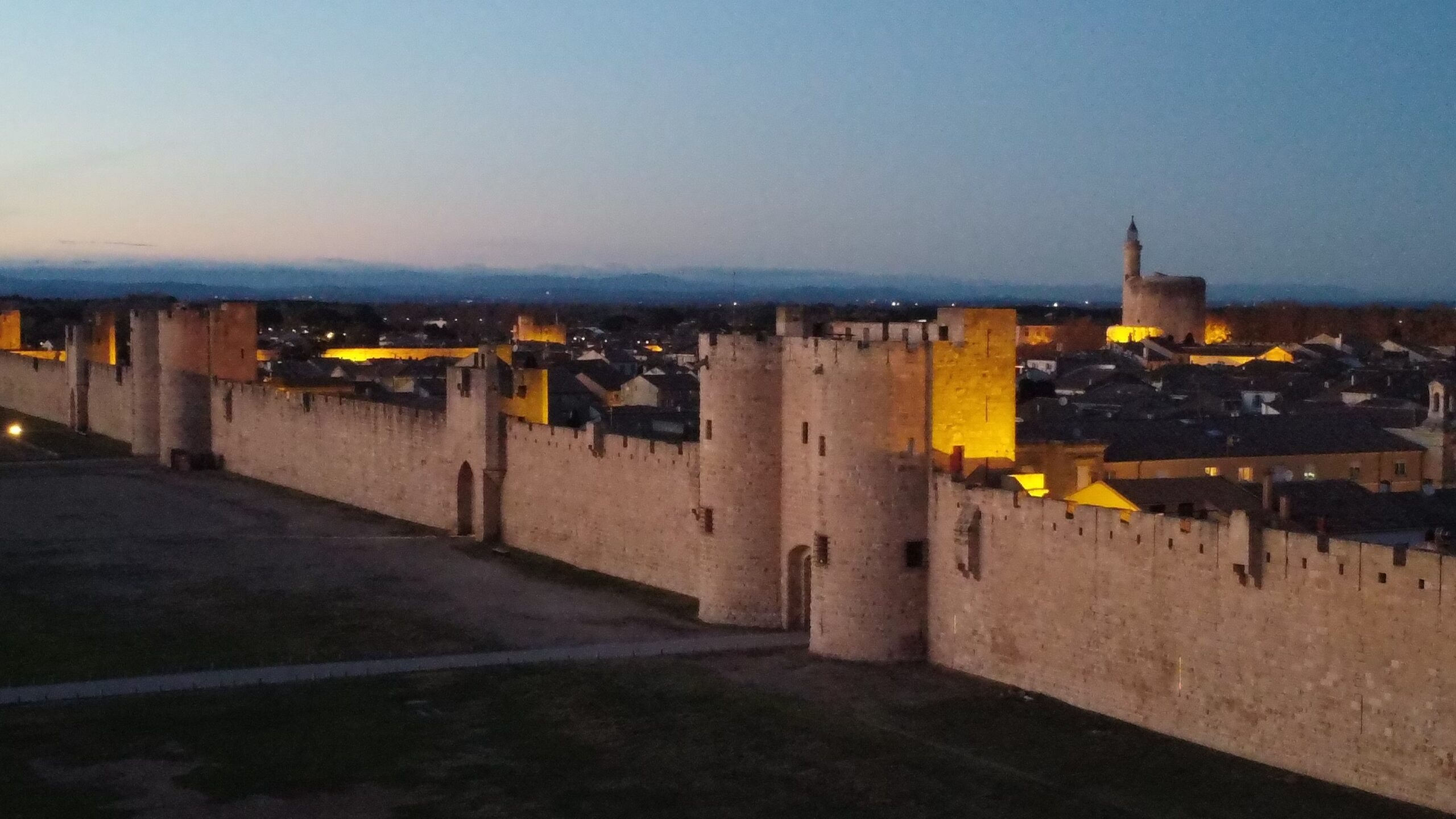
The ghost horse Lou Drapé, the White Lady, the treasure of the Templars, the weeping Virgin… For centuries, people in Aigues-Mortes have passed these stories down from one generation to the next.
Fifteen legends, retold to be read aloud in the evening – or on the very spot where they are set, as you walk along the ramparts.
A day in Aigues-Mortes
Only have one day? Here is the programme the author suggests – a full chapter from the practical guide, which you can also read for free in the Kindle sample.
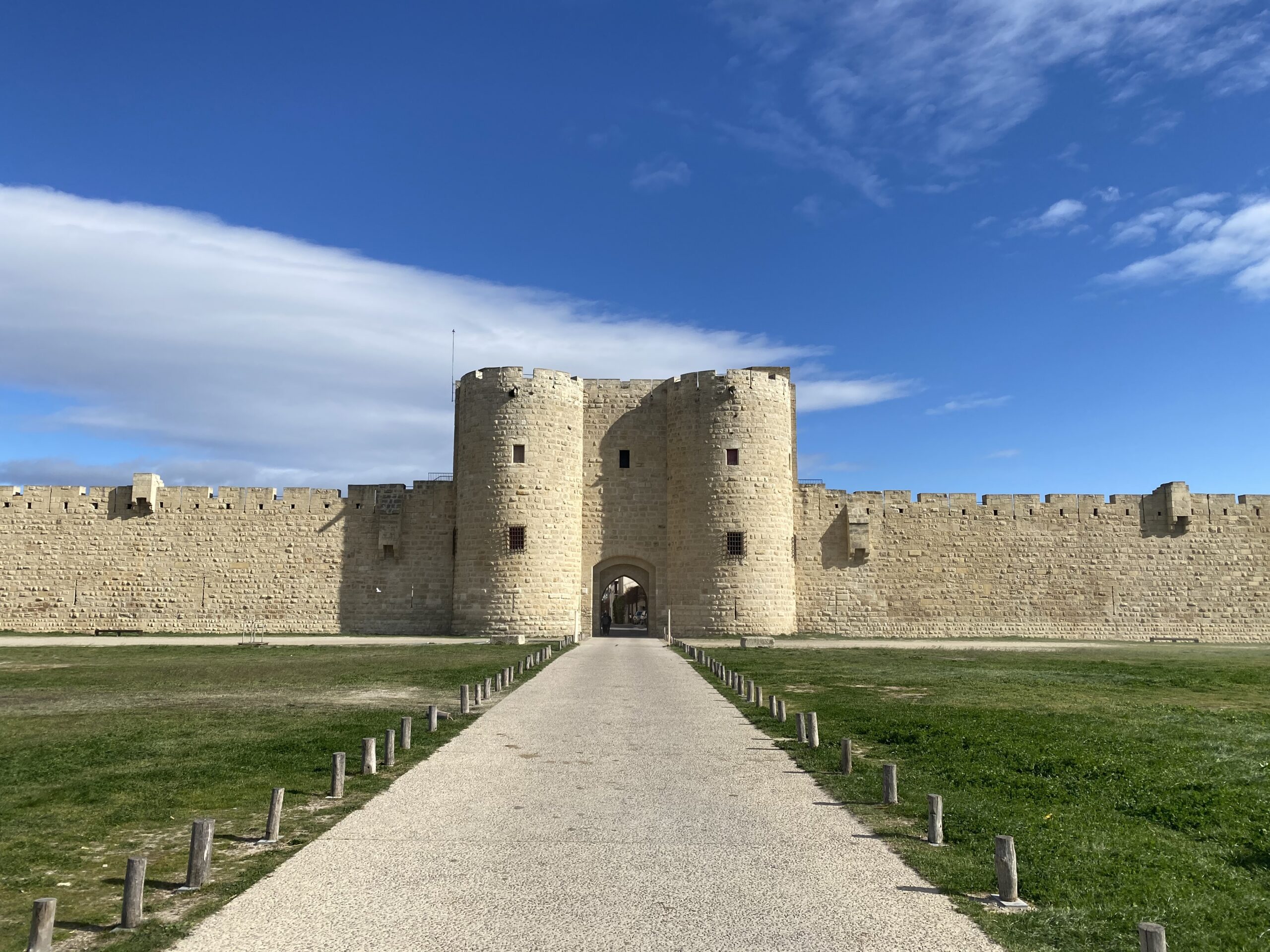
I have lived in Aigues-Mortes for more than twenty years. As soon as you walk through the ramparts you feel you are entering another world: you slow down naturally, the historic centre is best explored on foot, and you stroll without stress through the pedestrian area inside the walls. If you only have one day, here is the programme I suggest.
The morning
The tourist train (Petit train) may seem something of a cliché, and yet I recommend it to start with, especially with children: you go right around the town with explanations that are easy to follow. Departure and tickets are at the Porte de la Gardette; booking is only needed for groups. It generally runs from April to the end of September, and during the French autumn half-term holidays. Right next to it is the only entrance to the Towers and Ramparts.
Practical details: departure from the Porte de la Gardette, next to car park P1. The ride lasts about 25 minutes, with a departure roughly every 40 minutes. Adults €6, children €3, free for under-4s. The commentary is available in several languages, including English. Information: petittrain-aiguesmortes.fr.
The guided tour "Tout est faux !" ("It's All Wrong!"), which I lead myself, takes a hard look at the town's myths and legends. It meets at 11 am on the Place Saint-Louis, and booking is required. The tour is in French; the book includes a self-guided walk along the same route in English.
Lunchtime
Before lunch, take a stroll through the streets inside the ramparts. You will find my favourite places to eat in the book's chapter "Eating and drinking".
The afternoon: four options
- The Towers and Ramparts. There is an entrance fee. You walk along the wall-walk and climb the towers, including the Tour de Constance.
- The salt works. You can explore them on foot, by bike or on a little train, though it does not run all year.
- The Maison du Grand Site de France. Admission is free; a nature trail runs through the middle of the lagoons. In my view, it is a must-see.
- A boat trip in the Camargue. It follows the canals and stops at a manade, a ranch where Camargue bulls are raised.
For sunset I recommend the southern ramparts: the town gates stand out against the sky, and the salt works are a few steps away. It is an excellent spot for photographs.
Good to know
Is one day enough? Not really: the town deserves more time. With children, allow at least two days so you can enjoy it without rushing.
When to visit? Spring and autumn. The French Easter and autumn half-term holidays are ideal; in autumn it is slightly milder on average, but it rains a little more often. If you are not tied to school holidays, choose September rather than June: in June it can already be very hot (the record temperature in Aigues-Mortes, 40.9 °C, dates from June 2019). In high summer, visit early in the morning or late in the afternoon.
What to bring? Sun cream, a hat, a full water bottle and a charged smartphone for photos. A small pair of binoculars is a pleasure on the ramparts and in the salt works.
Visiting with a pushchair? It is possible, even on the cobbled streets; in high summer, when it is crowded, it gets harder. For the visit to the Towers and Ramparts, the pushchair stays at reception.
Where to park? See parking and electric car charging below.
The book goes on with two step-by-step walking tours, the full ramparts visit, parking maps, restaurants, places to stay – and the 12 myths and 15 legends. Get your copy.
Where to park in Aigues-Mortes
The first question almost every visitor asks. Here is the author's advice, also taken from the practical guide.
Parking inside the ramparts is reserved for residents, hotel guests and the emergency services. Visitors park in one of the car parks around the ramparts. It is generally fairly easy to find a space; in early August it is harder, but it is extremely rare to find none at all.
Which car park?
- P2 and P3 are right at the foot of the ramparts. They are pay car parks and often full at weekends and during the holidays.
- P4 and P5 more often have space. P4 is a large unsurfaced area; when it is very busy, getting out can take a long time.
- P6 and P7 are pay car parks (ticket machines) and closed on Wednesday and Saturday mornings, which are market days. Checks are frequent.
- P8 is free but small; allow about ten minutes on foot.
- The Constance car park, at the entrance to the town on the station side, is also free, about ten minutes' walk from the ramparts.
- P9 is the cheapest of the pay car parks, about fifteen minutes' walk from the ramparts.
By motorhome
There is only one option: car park P4, almost at the foot of the eastern ramparts. It has a service point, water connections, household waste disposal, grey- and black-water emptying and public toilets. The only drawback: in summer it is extremely dusty.
Charging an electric car
It is not easy – I know what I am talking about, I have one. Near the ramparts there are four charging points on the reGARD network: two in the Rue du Faubourg de la Fraternité (five to ten minutes from the ramparts) and two on the Chemin du Mas d'Avon (ten minutes), rarely in use at the same time. The town has also installed new charging points in the Constance car park and in P8; they are expensive for slow charging.
There is no rapid charging in the immediate vicinity of the ramparts. The most reliable solution is the rapid chargers in the Lidl car park and in the neighbouring business park, at varying prices. The cheapest is still Lidl, with the Lidl Plus card.
Information checked in autumn 2026. Prices, opening times and timetables may change.
In the book, you'll find maps showing every car park and charging point. Get your copy.
Not planning a trip? It's still for you
Two of the three books in this volume are not about travel at all, but about history and storytelling. You don't need to be coming to Aigues-Mortes to enjoy them.
You've already visited
Find out what you really saw – and which of the stories you heard on the day were true.
You love history and legends
A medieval town told through its myths and its folklore: a journey you can take from your armchair.
You're looking for a gift
For a friend who loves France, the South, medieval history – or who still talks about their holiday in the Camargue.
About the author
Get your copy
Read it before you come, carry it with you on the ramparts – or enjoy it at home. Choose the Amazon store for your country:
Free to read with Kindle Unlimited. Paperback: 173 pages, 12.7 × 20.3 cm, ISBN 979-8161881514.
Frequently asked questions
Is this book worth reading if I'm not going to Aigues-Mortes?
Yes. The myths and the legends – two thirds of the book – are about history and storytelling, not travel. They can be enjoyed anywhere, whether you have visited the town, plan to, or simply love medieval France.
Is it useful if I'm only visiting for a day?
Yes. The practical guide includes a step-by-step plan for a day in Aigues-Mortes, where to park, and a walking tour you can follow on your own.
Kindle or paperback – which should I choose?
The Kindle edition is handy on your phone while you walk around town. The paperback is nice to read beforehand, to keep as a souvenir or to give as a gift.
Is it suitable for families with children?
Yes – there is a section of tips for families, and the legends are written to be read aloud.
Does it cover the Camargue too?
It includes excursions just outside the town, to the salt works and the Camargue.